
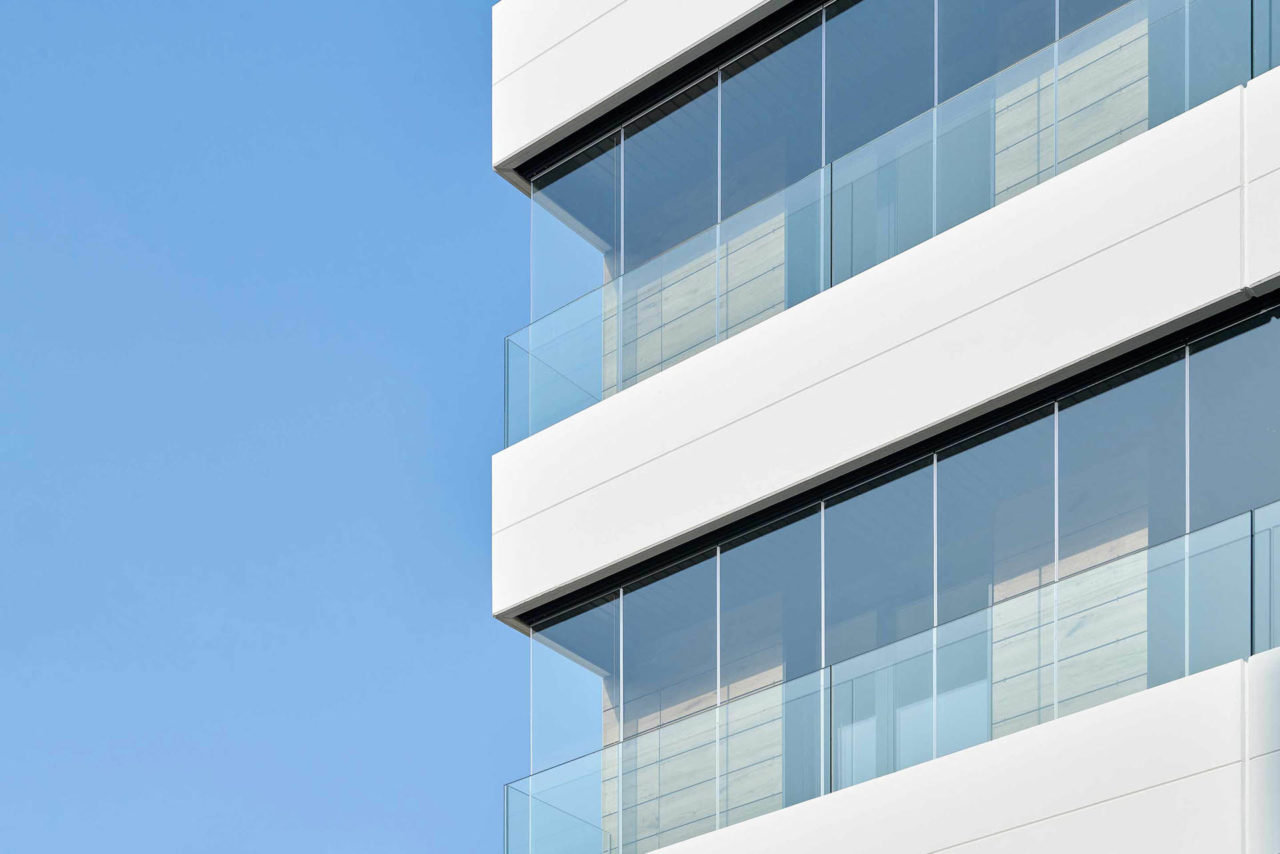
Our Integrated and Energy-Saving Balcony Systems
Integrated balcony systems are changing what energy efficiency looks like.
All production creates emissions, but few products offset their environmental impact as fast as balcony glazing. On average, it takes three years to compensate for the emissions from manufacturing, transport, and installation, not counting ongoing energy savings.
Carbon dioxide emissions may be estimated by using a formula, in which the carbon dioxide emissions that result from the manufacture of one balcony glazing solution correspond to driving a car for 1,000 kilometres. The positive environmental impacts that have been caused by the glazing include the reduced heating costs and the reduced reparation need of the facade of the building, for example.
According to scientific studies that have been made in Finland and around the world, the heating energy savings will typically vary from 2 to 20 % in the European area.
Our materials consist of 95 % of glass and aluminum—the recycling degree of raw materials is 95%
Themes, like the environment, recycling of materials and reduced carbon footprint, are very important to Lumon. The purpose of our different projects that relate to the environment and the optimization of our production is to use the most advanced methods in our production plant to reduce the amount of material waste and environmental hazards. The percentage of glass and aluminum in the Lumon balcony and terrace glass products is 95 %. They are almost entirely suitable raw materials for recycling. At Lumon, the percentage of glass and aluminum-based cutting waste in our production plant is up to 95 %. The waste materials are used for producing reusable raw materials in the recycling plant.
By the way, did you know that roughly 75 % of produced aluminum materials is still in use, or that the proportion of recycled glass in the Lumon glazing solutions is about 20%?
The glass sections are cut to size of the object, so that all factors that relate to the functionality of the glazing can be considered in advance. The unique custom-made products enable Lumon to produce a glazing solution that fits completely in with each object, no matter whether the question is of one or several hundreds of balconies. It could be imagined that custom-made products would increase the amount of material waste in our production, but the situation is quite the opposite. When the products are custom-made and their size is exactly right, there is no need to order additional sections afterwards or to replace any glass sections with more suitable ones.
Our principle of ”All to be put in order at one go” will save our materials, energy and capacity. We avoid paying additional visits to customers for the sake of repairs, and, thus, we and the customer save a lot of time and trouble.
Not only do we at Lumon recycle our raw materials but also our packing materials: we have also invested in and improved the recycling system of packing materials. Over the years, we have reused the pallets and spacers that have been used in the glass packages. After installation, the reusable packing materials will be returned to the plant and recycled further. Last year, we made a variety of tests and could, thus, reduce the number of spacers by 25%.
They are used between glass panes. The reduced amount of packing materials will also provide the company with economic savings. Even more delightful is to note that the reduced amount of carbon dioxide emissions has also reduced the need to produce and deliver new packing materials to Lumon.
-
Patio Covers vs. Retractable Glazing for Hospitality
Read more…Your patio generates revenue, but only when guests are actually sitting in it. A short patio season can mean only four or five months of active use, while the space continues to incur operating costs throughout the year.
-
-

A Developer’s Guide to Retrofitting Aging Condos
Read more…Canada’s aging condo towers are hitting a turning point: the envelope, not the floor plan, now drives renovation decisions. Rather than a burden, façade modernization is a chance to give buildings more flexibility and control over how they perform and hold value.